Independent Review · 2026

SakuraCat VPN Review: A Cheap Node-Reseller Service That's Fine – Not Great

6.5/10 Decent budget option

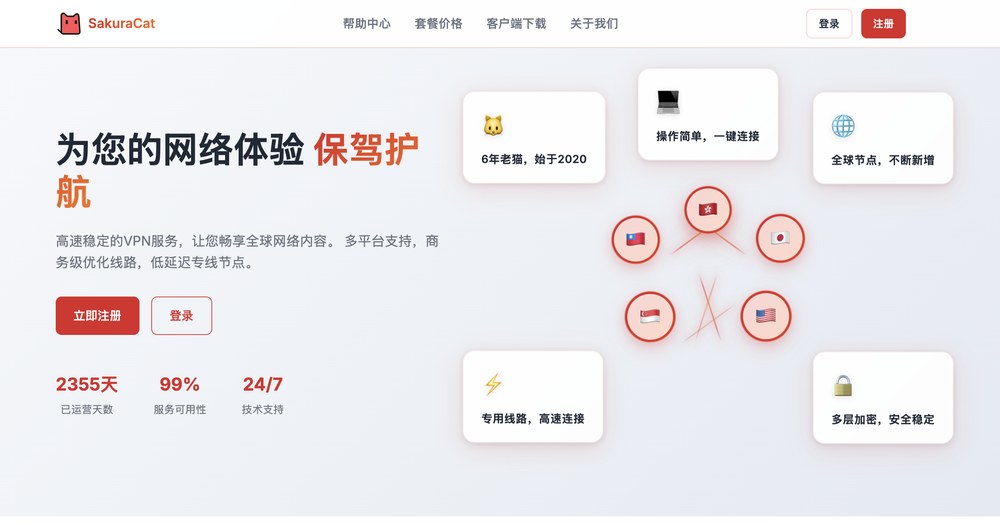
SakuraCat is a small proxy/acceleration service aimed primarily at Chinese-speaking users, built around IEPL leased-line routing and unusually low entry prices. After researching its public documentation, pricing structure, and client apps, our take is straightforward: it's a reasonable pick for budget-conscious users who mostly want stable streaming access – but it falls well short of established VPN providers on audit transparency, protocol disclosure, and team scale. If you searched for a SakuraCat VPN review, this article lays out both sides honestly.

Global network and data line illustration

This is an independent review site. We have no partnership with or endorsement from SakuraCat / MeowSec Tech LLC.

Quick Overview: What Is SakuraCat?

Founded six years ago and operated by MeowSec Tech LLC, described on its site as an overseas (non-mainland-China) team.

Overall Score
6.5
out of 10
Starting Price
¥3.8
/month (basic tier)
Regions
27+
in the advanced tier
Device Cap
3
simultaneous devices
Years Active
6
per site's own history
Third-Party Audit
None found
not published on site

Pros and Cons

An honest look at where SakuraCat holds up and where it falls short.

    Pros

  • Entry plan starts at just ¥3.80/month – genuinely cheap by market standards
  • Uses IEPL business-grade leased lines, which are typically more stable than shared bandwidth
  • 27 regions in the advanced tier is reasonable coverage for personal use
  • Unlimited-time data packages available for users who don't want a recurring subscription
  • Official apps for Windows, macOS, Android, and iOS – the iOS app ships through the App Store
  • Android app supports per-app split tunneling
  • Six years in operation – not a fly-by-night service
  • Cons

  • No published third-party security audit or independent verification of the no-logs claim
  • Underlying tunnel/proxy protocol isn't disclosed, making encryption strength hard to independently assess
  • No official Linux client – Linux users are left to fend for themselves
  • Hard cap of 3 simultaneous devices, well below "unlimited" services like Surfshark
  • Small team size raises real questions about long-term stability and capacity to scale
  • No published independent speed-test data; real-world throughput will vary by route and time of day

Security and Privacy: Marketing Claims vs. What We Could Verify

SakuraCat makes several security claims on its site. Here's how each holds up under scrutiny.

"Military-Grade Encryption"

The site advertises AES-256 encryption, a legitimate and widely used symmetric cipher. "Military-grade" is marketing language, though – what actually matters is whether the protocol implementation is sound, and SakuraCat doesn't publish those details.

"No-Logs Policy"

SakuraCat states its nodes don't store users' regular browsing activity. This is a one-sided policy statement with no accompanying third-party audit – comparable to most small proxy services, and something users have to take largely on trust rather than as independently verified fact.

IEPL Business Lines

IEPL (International Ethernet Private Line) routing is a common selling point among Chinese-market acceleration services, and generally does mean more stable, lower-latency routing than standard international bandwidth. This is a credible technical claim, but actual line quality depends on the specific bandwidth and node capacity the provider has purchased – details SakuraCat doesn't disclose.

"Overseas Team" Claim

The site emphasizes being run by a "genuine, mature overseas (non-mainland-China) team" – common phrasing among China-facing proxy services intended to ease data-sovereignty concerns, but again unaccompanied by verifiable company registration or operating-location details.

If you want to understand VPN privacy fundamentals, Cloudflare's technical explainer on how VPNs work is a useful primer on encrypted tunneling and traffic proxying – helpful context for evaluating marketing language from smaller providers like SakuraCat with a level head.

Plans and Pricing: ¥3.80 to ¥28.80 per Month

SakuraCat's pricing scales by data allowance and node tier, spanning light to moderate usage.

PlanPriceDataNode Range
Micro X Basic¥3.80/mo10 GBBasic tier (5 regions)
Light X Basic¥5.80/mo45 GBBasic tier (5 regions)
Medium X Advanced¥8.80/mo95 GBAdvanced tier (27 regions)
Large X Advanced¥10.80/mo150 GBAdvanced tier (27 regions)
Huge X Advanced¥13.80/mo210 GBAdvanced tier (27 regions)
Max X Advanced¥28.80/mo480 GBAdvanced tier (27 regions)

SakuraCat also offers three unlimited-time data packages (¥9.80 / ¥19.80 / ¥38.80) – a one-time purchase, valid until the data runs out, though these can't be stacked and each has a fixed ceiling. Every plan – regardless of price – caps you at 3 simultaneous devices.

Node Coverage: Basic vs. Advanced Tier

Basic Tier

5 Popular Regions

Hong Kong, Japan, Singapore, Taiwan, and the United States – covers the nodes most people use for everyday browsing and streaming, suited to light users without a strong need for broad regional coverage.

Advanced Tier

27 Regions

Adds South Korea, Macau, Canada, Australia, the UK, France, Germany, Norway, Italy, Russia, Ukraine, the UAE, Turkey, Argentina, Brazil, India, Nigeria, the Philippines, Thailand, Vietnam, Malaysia, Indonesia, and more – a noticeably broader footprint useful for regional voting, shopping, or light gaming needs.

Shopping Nodes

Discount Shopping Regions

SakuraCat specifically calls out "low-price shopping nodes" in Russia, Turkey, Argentina, South Korea, and Macau, aimed at helping users access regional pricing for software subscriptions or goods – a common selling point in this category, with results that depend entirely on individual merchants' regional pricing.

Supported Platforms

Covers the major desktop and mobile systems – but notably not Linux.

Windows

Windows 7 and above, v2.0.0 client, one-click connect with automatic node selection.

Read Windows review →

Android

Android 5.0+, lightweight app, per-app split tunneling.

Read Android review →

iOS / macOS

iOS 12+ on the App Store; macOS 10.12+ with native Apple Silicon support.

Read iOS/macOS review →

Linux

No official Linux client is offered – see our dedicated analysis of what that means for Linux users.

Read Linux review →
Digital security and encryption concept

Is SakuraCat VPN Safe? Our Assessment

When people ask "is SakuraCat VPN safe," we lean toward a qualified yes: AES-256 encryption and IEPL lines are genuine technical measures, not empty marketing. But "safety" isn't only about the cipher – it also depends on a verifiable no-logs commitment, transparent corporate governance, and a track record of stable long-term operation. SakuraCat is thin on the latter two.

As EFF's Surveillance Self-Defense guide emphasizes, assessing any privacy tool depends heavily on your use case. If you just want reliable streaming access or a stable connection to common sites, a lightweight service like SakuraCat carries manageable risk. If your needs involve genuinely sensitive communication, an unaudited small provider generally isn't the right choice.

Our Verdict

SakuraCat is best understood as a pragmatic, "good enough" option: cheap, reasonably wide node coverage, and clients on all four major platforms except Linux. For budget-conscious users with simple needs – streaming, stable access, occasional cross-region shopping – it's a defensible pick. It is not what we'd recommend to anyone who prioritizes audited privacy claims, needs unlimited devices, or wants an industry-leading experience – those users are better served by a mainstream VPN with independent audits and more transparent terms. On balance, treating SakuraCat as a cheap, useful supplement rather than your only privacy tool is the sensible approach.

See Our Audited VPN Pick

Want More Comprehensive Protection?

If independent audits, unlimited devices, and mature terms of service matter more to you, take a look at our current top VPN recommendation.

See Recommendation →